Cut YouTube Research Time to Minutes: 5 Stage Workflow for Creators
Cut YouTube Research Time to Minutes: 5 Stage Workflow for Creators
A reliable YouTube research workflow runs five automated stages: discovery, ingestion, transcription, synthesis, and handoff. Chain them with an API pull, a transcript source, and an LLM, and you turn raw video signal into ready-to-produce research cards and script seeds. Done right, it cuts research time from hours to minutes while keeping the evidence trail intact.
TL;DR:
- Combining multiple search queries and manual filters is essential to mitigate YouTube’s recommendation bias and ensure dataset quality.
- Storing raw transcripts, query details, and video provenance metadata is critical for transparency and auditability of research conclusions.
- Setting clear thresholds for views, engagement, and publish date, along with deduplication by video ID, helps maintain a focused and reliable dataset.
- Automating the attachment of research cards to content assets before filming ensures research findings influence production rather than remaining unused.
- Integrating tools like Baitless can streamline the synthesis stage, providing quick, human-checkable summaries that save valuable research time.
Table of Contents
- What Does a YouTube Research Workflow Look Like Step by Step?
- What Tools and Integrations Power This Pipeline?
- How Do You Set Up an Automated YouTube Research Workflow?
- How Do You Avoid Bias and Keep Your Data Trustworthy?
- What Belongs on a Research Card Before You Start Filming?
- The Translational Gap Nobody Talks About
- Where Baitless Fits Into Your Synthesis Step
- Sources
What Does a YouTube Research Workflow Look Like Step by Step?
Each stage in the pipeline produces a specific output that feeds the next one. Skip a stage, and you lose the paper trail that makes the final research card trustworthy.
- Discovery — Run a handful of search queries around your topic, not just one. Sample broadly to counteract the recommendation engine’s own bias toward what’s already popular.
- Ingestion — Pull metadata through the API: title, publish date, view count, like count, duration, channel size. Capture everything now; you can filter later.
- Transcription — Fetch the transcript and run a quick quality check. Auto-captions on niche or accented content drift more than people expect.
- Synthesis — Feed the cleaned transcript to an LLM for a summary, timestamped highlights, and topic tags.
- Handoff — Package the summary into a research card with fields that plug straight into a script draft or thumbnail brief.
Check early signals like impressions and click-through rate around the two-hour mark, then longer retention data around two days, if you’re evaluating your own channel’s content alongside competitor research.
What Tools and Integrations Power This Pipeline?
The pipeline only needs four moving parts: a data source, a transcript source, a language model, and somewhere to store the output. What you choose for each depends on volume and how much manual review you want in the loop.
- YouTube Data API: handles search and stats retrieval. You’ll need an API key or OAuth credentials, and a search quota you should budget carefully since heavy discovery queries burn through it fast.
- Transcript source: either the platform’s own caption track or a third-party transcript puller. Auto-captions are free but noisier on jargon-heavy or accented speech; a dedicated transcription service costs more but produces cleaner text for summarization.
- LLM summarizer: OpenAI or Gemini models both work well for this. Prompt patterns that ask for a one-sentence thesis, three evidence points with timestamps, and a suggested angle tend to produce the most usable output.
- Storage: Google Sheets or Airtable for lightweight setups, Notion for teams that want richer documentation. A spreadsheet-backed workspace also makes it easy to sync annotations without losing the transcript-to-analysis trail.
- Orchestration: n8n and Make both support this chain natively, with dedupe and filter nodes that stop the same video from clogging your sheet twice.
Pro Tip: Keep raw API responses in a hidden tab of your sheet. When a summary looks off weeks later, you’ll want to check the original numbers instead of trusting your memory.
How Do You Set Up an Automated YouTube Research Workflow?
A working template needs four credentials and a fixed node order. Get those right and the rest is mostly filter tuning.
- Set up credentials: a YouTube Data API key, OAuth if you need private analytics, and an API key for your chosen LLM. Watch your daily quota. The YouTube API’s default search quota burns fast if your discovery step runs multiple broad queries.
- Build the node chain: form trigger → YouTube search → fetch video stats → filter → pull transcript → LLM summarizer → write to sheet. This sequence mirrors what shows up repeatedly across published n8n community templates, including dedicated trend-finding agent workflows.
- Set filter thresholds: a minimum view count relative to channel size, an engagement rate (likes plus comments divided by views), and a publish window, say the last 90 days. Deduplicate by video ID before the transcript step to avoid paying for the same summary twice.
- Define your output schema: title, URL, publish date, views, likes, engagement rate, summary, tags, and suggested hooks. Lock this schema before your first run so every row lines up.
- Schedule incremental runs: daily or weekly, with a “last checked” timestamp column so the workflow only processes new videos instead of reprocessing your whole dataset.
How Do You Avoid Bias and Keep Your Data Trustworthy?
YouTube search is not a research database, and treating it like one is the most common mistake in automated pipelines. HCI research on online video studies recommends treating each search as a purposeful sample and running multiple query variants rather than trusting one search string to represent a topic.
- Combine at least three to five differently phrased queries per topic before you trust the resulting dataset.
- Set conservative filters, but manually review what they exclude. A rigid view-count cutoff can quietly drop a small channel with an unusually strong format worth studying.
- Store the raw transcript, the timestamp, and the exact query that surfaced each video. That provenance is what lets someone else audit your conclusion later.
- Sync your research into one spreadsheet-backed workspace rather than scattering it across chat exports and screenshots. Scaling qualitative video work depends on keeping transcripts, annotations, and source data connected instead of siloed.
- Add a human checkpoint before any summary influences a creative decision. An LLM can misread sarcasm or context in a way that skews a highlight completely.
None of this needs to be manual. It needs to be logged, and logging is the part automation handles well.
What Belongs on a Research Card Before You Start Filming?
The synthesis stage is worthless if the output never reaches the person writing the script. A research card should carry a one-sentence hook, three evidence bullets with timestamps pulled from the transcript, a suggested call-to-action, and a short script seed built from the same summary.
- Auto-generate two or three title variants and a thumbnail hypothesis directly from the summary text, so nobody retypes the idea from scratch later.
- Attach the card to a channel-scoped project rather than a loose document. The reasoning behind the idea needs to travel with it, not live in someone’s memory.
- Group similar cards by theme or playlist in your analytics before greenlighting anything. YouTube’s own guidance points toward finding repeatable formats this way instead of chasing single viral outliers.
- Run a quick pre-filming check: does this fit your audience, can you repeat the format next month, and does it fit a sustainable content mix, roughly 70% proven formats, 20% adjacent experiments, 10% pure risk.
A card missing any of these fields usually means someone has to reopen five browser tabs mid-script to find the detail that got left out.
The Translational Gap Nobody Talks About
Most automated research setups fail for a boring reason: the research never gets attached to the idea it was meant to support. Teams build elaborate discovery pipelines, generate sharp summaries, then paste them into a chat thread that nobody reopens by the time filming starts. The fix isn’t a smarter model. It’s attaching the research card to the production asset the moment synthesis finishes.
Start with one channel and one repeatable loop before you scale to five. A pipeline that reliably produces ten usable cards a week beats one that produces fifty nobody reads. Keep a human in the loop at the creative and ethical checkpoints. Automation should remove copying and searching, not judgment.
— Sergio
Where Baitless Fits Into Your Synthesis Step
Baitless slots directly into the synthesis stage, the point where your pipeline turns a raw transcript into something a script writer can actually use. Instead of configuring a custom LLM summarizer, the Chrome extension generates a concise summary with timestamped highlights for any video you feed it, letting you see what to watch and what to skip before you commit research time to it.
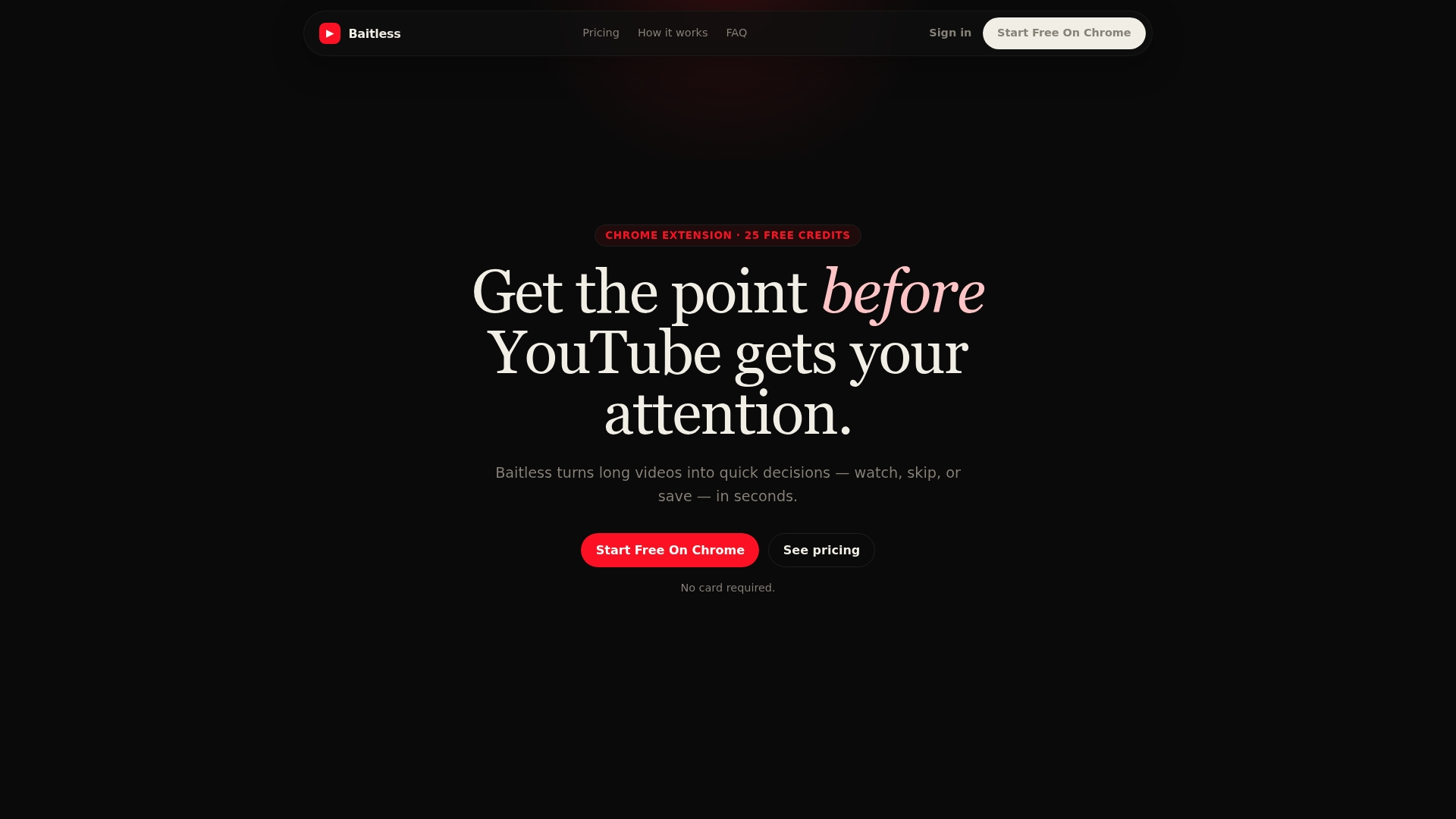
The free tier gives you 25 summary credits, enough to test the extension against a batch of competitor videos before deciding whether to subscribe. Daily researchers who burn through free credits fast can move to a paid plan built for volume use. You can drop Baitless in as a first-pass, human-checkable summary layer ahead of your own LLM step, or use it as the entire synthesis stage for smaller research sprints. Browse how other creators structure AI summary workflows for YouTube videos, then install the extension and run your first summary against tomorrow’s research list.