
Video Summarization Explained: Pick the Right Format Fast
Video Summarization Explained: Pick the Right Format Fast

Video summarization is the automated process of condensing a long video into a shorter output, either a set of representative still frames (a storyboard) or a stitched clip of key moments (a skim). The choice between them comes down to what you need next.
- Want to scan fast without pressing play? Choose a storyboard.
- Want to watch a condensed version with audio and motion intact? Choose a dynamic skim.
The underlying pipeline, described in a PMC review of summarization taxonomy, always moves through segmentation, importance judgment, and selection, no matter which output you’re after. Benchmark datasets like SumMe and TVSum, alongside a growing body of survey literature, give the field its shared vocabulary and its shared yardsticks.
Key Takeaways
The right video summary format depends entirely on your goal: storyboards for fast scanning, dynamic skims for content where audio and motion carry the meaning.
Where to Read More
- PMC review on summarization taxonomy: defines static vs. dynamic outputs and the segmentation-to-selection pipeline.
- ACM survey on deep learning and optimization: covers cross-domain applications and multi-view challenges.
- Comprehensive review of summarization techniques: explains extractive/abstractive methods and SumMe/TVSum benchmarks.
- Deep-learning survey: details CNN feature extraction and knapsack-style selection.
- For a fast, no-setup path to YouTube summaries, visit Baitless.
Table of Contents
- What Is Video Summarization and Why Does It Matter Now?
- Static or Dynamic, Extractive or Abstractive: What’s the Difference?
- How Does Video Summarization Actually Work?
- How Do You Know if a Summary Is Actually Good?
- Which Summary Format Fits Your Goal?
- What’s a Practical Workflow for Producing a Summary?
- Want Summaries Without Building a Pipeline Yourself?
- Frequently Asked Questions
- Sources
What Is Video Summarization and Why Does It Matter Now?
Video summarization takes a long recording, a lecture, a security feed, a two-hour vlog, and produces something short enough to actually review. A static summary pulls a handful of representative frames into a storyboard you can flip through in seconds. A dynamic summary stitches together short clips into a skim you watch instead of the full source, preserving audio and motion in the process.
The urgency behind this isn’t hypothetical. Video archives in corporate, educational, and surveillance settings are growing faster than any human team can review manually, a point survey authors have made repeatedly when explaining why automated summarization has become essential across sports, education, and security footage. Nobody has time to rewatch every recorded meeting or every hour of lecture capture.
That pressure shows up differently depending on the field:
- Education: condensing hour-long lectures into skimmable segments for exam review.
- Surveillance: surfacing the handful of minutes where something actually happened.
- Media: generating trailers or highlight reels from raw footage.
- Research and knowledge work: letting you decide in 30 seconds whether a video is worth your full attention.
Static or Dynamic, Extractive or Abstractive: What’s the Difference?
Every summarization method makes two independent choices: what format to output, and how to build it. Getting these straight prevents a lot of confusion when you’re comparing tools or reading method papers.
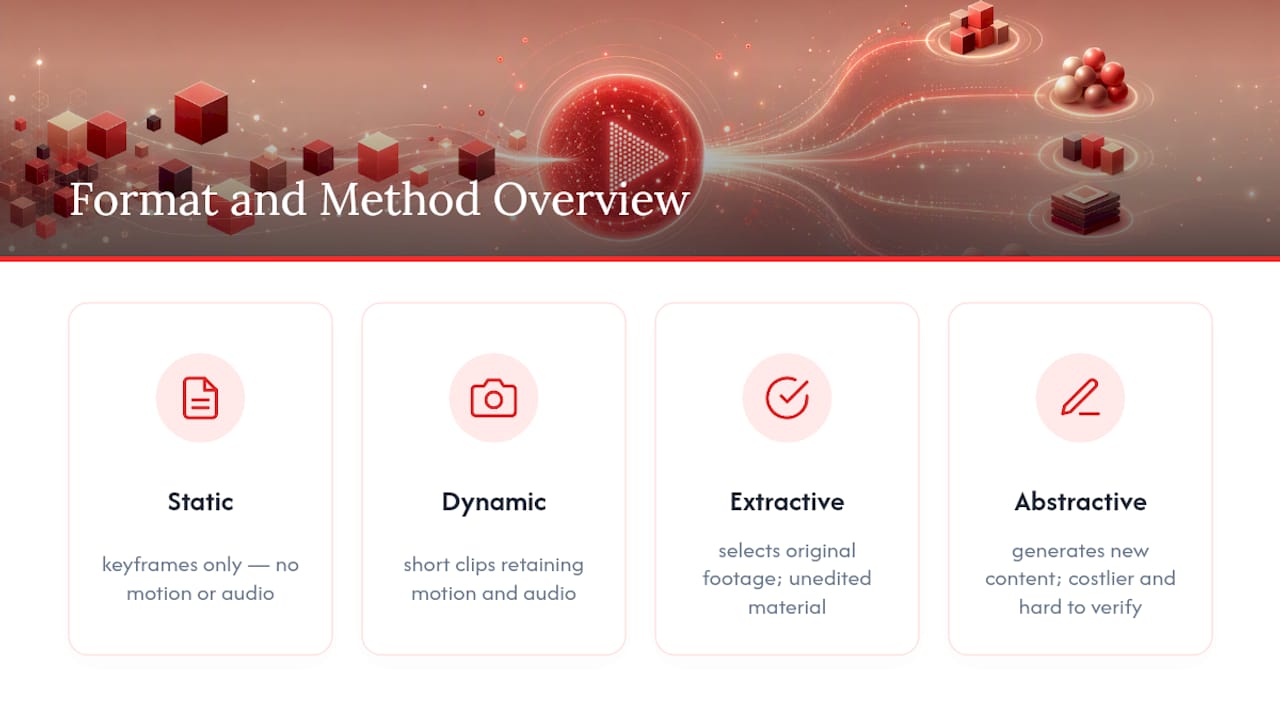
Static summaries (storyboards) are a curated set of keyframes. You skim them the way you’d skim a photo contact sheet. They lose motion and audio entirely, but you can absorb one in seconds, which is why they work well for quick review or indexing.
Dynamic summaries (skims) are short video clips assembled from the original footage. Because they retain audio and motion, they suit content where how something happens matters, like a lecture’s explanation or a game’s momentum shift, a distinction the comprehensive review of summarization techniques draws out clearly.
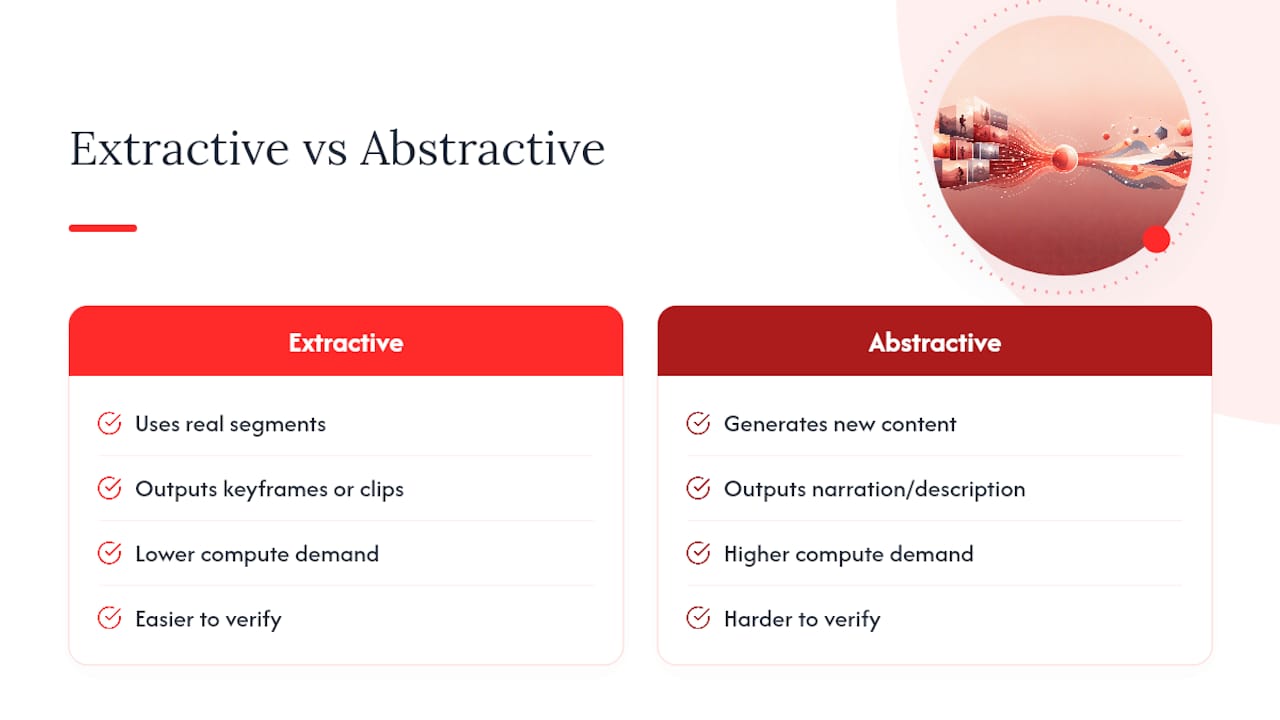
Separately, methods split into extractive and abstractive approaches. Extractive summarization selects and reassembles pieces of the original footage, so what you see is always real, unedited source material. Abstractive summarization generates new content, often textual narration describing what happened, using generative models like GANs and multimodal learning. Abstractive methods are more computationally expensive and harder to verify for accuracy.
One more wrinkle: single-view versus multi-view summarization. A single camera feed is straightforward to segment and score. Multiple synchronized feeds, common in surveillance or multi-camera event coverage, require the system to align timestamps and resolve overlapping content before it can even start scoring importance.
How Does Video Summarization Actually Work?
Nearly every summarization system, regardless of format or method family, follows the same four-stage pipeline:
- Segmentation. The video gets broken into shots or temporal segments, usually by detecting scene changes or motion discontinuities.
- Feature extraction. Each segment is converted into numerical features, visual (frame content), audio (speech, music, silence), and sometimes text (captions, transcripts).
- Importance scoring. A model assigns each segment a score reflecting how “important” or representative it is.
- Selection and assembly. The highest-scoring segments get selected, often through an optimization process, and stitched into the final summary.
That third and fourth stage is where methods diverge most. Broadly, four families dominate the field:
- Heuristic methods use hand-built rules or clustering, no training data required, but they’re rigid and don’t generalize well.
- Supervised methods learn importance scoring from labeled datasets, producing stronger results but requiring annotated training data that’s expensive to produce.
- Unsupervised methods rely on diversity, representativeness, or reconstruction quality (often via GANs) instead of labels, useful when no ground-truth summaries exist.
- Deep-learning methods, the current frontier, lean on RNNs and LSTMs for temporal modeling, attention and transformer architectures for weighing long-range dependencies, and GANs for unsupervised generation.
Under the hood, a typical deep-learning pipeline extracts frame-level features using a pre-trained CNN, scores importance with an attention or LSTM-based model, then selects the final segment set by solving something close to a knapsack problem, maximizing total importance within a length budget. Research on deep-learning-based summarization commonly sets that budget at roughly 15% of the original video’s length, written as p≈0.15, a useful starting ratio if you’re building or evaluating your own system.
The trade-offs matter in practice. Supervised deep learning tends to produce the most coherent summaries but needs labeled data you may not have. Unsupervised and GAN-based methods skip that requirement but can produce less temporally coherent output. And whether you include audio at all changes which method family even makes sense: a purely visual approach throws away information a lecture or podcast summary needs to preserve.
How Do You Know if a Summary Is Actually Good?
Evaluating a summary is trickier than it sounds, because “important” is partly subjective. Two people watching the same lecture might flag different five-minute segments as the ones worth keeping.
Researchers work around this with standardized benchmarks. SumMe and TVSum are the two datasets nearly every method paper reports results against, letting different approaches be compared on the same footage with the same human-annotated ground truth. Evaluation typically uses F-score, precision, and recall to measure overlap between a generated summary and human-selected segments, while text-based or abstractive summaries sometimes borrow ROUGE-style measures from natural language processing.
Even with SumMe and TVSum as shared references, the field still hasn’t solved evaluation. Standardized datasets make comparison possible, but they don’t capture every domain’s notion of what matters, a gap the Video Summarization Overview survey flags directly.
That gap shows up as real limitations:
- Subjective “interestingness” means benchmark scores don’t always predict how useful a summary feels in practice.
- Domain dependence means a method tuned on sports footage may perform poorly on lecture video.
- Multi-view synchronization remains a harder, less-solved problem than single-camera summarization.
Open challenges include better personalization, more accurate abstractive generation, and skims that stay coherent under tight length constraints.
Which Summary Format Fits Your Goal?
The “best” summary type isn’t universal. It depends entirely on what you’re trying to accomplish, a point research on user-intent-driven evaluation makes explicit: a summary built for learning needs different priorities than one built for entertainment or quick retrieval.
Match your intent to a format:
- Learning a skill or following instructions: choose a dynamic skim that preserves audio, since instructional value often lives in narration, not just visuals.
- Reviewing or scanning for relevance: choose a storyboard with timestamps, since you can evaluate several frames faster than watching seconds of video.
- Finding a specific event (surveillance, sports highlights): prioritize high recall in a skim, even at the cost of some extra length.
- Deciding whether to watch something at all: a storyboard plus a short text breakdown usually beats either format alone.
Tighter ratios save more time but risk cutting connective context.
Resource constraints matter too. Multi-view footage, limited compute, or a lack of labeled training data all push you toward simpler heuristic or unsupervised methods rather than a custom deep-learning pipeline.
Pro Tip: If your goal is pure productivity, like deciding whether a 40-minute YouTube video is worth your time, a storyboard paired with text highlights almost always beats a skim. You can scan it in seconds without buffering a single frame of video.
What’s a Practical Workflow for Producing a Summary?
You don’t need a research lab to apply this. Here’s a checklist that works whether you’re building something custom or just deciding how to consume a video faster:
- Define your intent. Learning, reviewing, event-finding, or a quick watch/skip decision.
- Choose your format. Storyboard for scanning, dynamic skim for watching.
- Decide what to preserve. Audio and motion for instructional content, visuals alone for quick review.
- Run segmentation and feature extraction if you’re building a pipeline, or let a tool handle this step.
- Score and select the highest-value segments against your length target.
- Assemble and do a quick quality check. Watch three or four key moments to confirm nothing critical got cut.
- Export with timestamps so you can jump back into the full video if needed.
For YouTube-specific content, running a full custom pipeline is overkill for most people. Reserve a custom deep-learning pipeline for cases where you need domain-specific tuning, like proprietary surveillance footage or multi-view synchronization.
Whatever your source, always spot-check: watch the flagged key moments, confirm continuity between clips, and verify that instructional steps or critical events weren’t dropped during selection.
Where Is This Technology Headed?
I think the next real jump comes from transformer-based attention models getting better at personalization, tuning importance scoring to an individual’s actual intent rather than a generic notion of “interesting.” Multi-view synchronization will keep improving too. For working professionals, that translates into faster triage of recorded meetings and sharper, more trustworthy auto-generated notes.
Want Summaries Without Building a Pipeline Yourself?
Baitless turns that entire workflow into a browser click. Instead of learning segmentation and importance scoring, you get an instant breakdown of any YouTube video, what to watch, what to skip, and why, so you can make the watch-or-pass decision in seconds instead of minutes.
Here’s what you get:
- Quick, AI-generated summaries built specifically for YouTube’s format and length range.
- Highlighted key moments so you see what matters without scrubbing the timeline yourself.
- A free tier with 25 summary credits, plus an affordable subscription for daily use once you outgrow it.
If you’re a busy professional, student, or researcher who watches YouTube for information rather than entertainment, install the Baitless Chrome extension and run your first summary on whatever video is sitting in your tabs right now.
Frequently Asked Questions
What is video summarization, in plain terms? It’s the process of shrinking a long video into a shorter output, either still keyframes or a stitched short clip, so you can grasp the content without watching the whole thing.
What’s the difference between extractive and abstractive summarization? Extractive summarization selects and reuses real segments from the original video. Abstractive summarization generates new content, like narration, describing what happened, which is more computationally demanding and harder to verify.
Which video summarization techniques are most common today? Heuristic clustering, supervised importance scoring, unsupervised reconstruction methods, and deep-learning approaches using attention, transformers, and GANs are the four dominant families right now.
How is a video summary evaluated for quality? Most methods report F-score, precision, and recall against human-annotated benchmarks like SumMe and TVSum. Text-heavy or abstractive summaries sometimes use ROUGE-style scoring instead.
Do I need to understand video summarization algorithms to use a summarization tool? No. Understanding the pipeline helps you judge output quality, but tools like Baitless handle segmentation, scoring, and assembly automatically for YouTube content.
Sources
- PMCID: PMC9869028 — video summarization definition and taxonomy (industry research, early 2026)
- ACM Transactions survey: Video Summarization Using Deep Learning and Optimization Approaches (ACM DOI:10.1145/3798047)
- Video Summarization Techniques: A Comprehensive Review (arXiv / ar5iv)
- A comprehensive survey of deep-learning-based video summarization (ar5iv / 2101.06072)
- MDPI Applied Sciences — on user-intent-driven summaries and evaluation (2023)