Try 25 Free YouTube Summaries in Chrome and Verify with Timestamps
Try 25 Free YouTube Summaries in Chrome and Verify with Timestamps

You can get a summary of almost any YouTube video in Chrome by installing a summarizer extension, opening the video, and clicking the extension to generate a transcript-driven summary. Use the timestamps it gives you to jump back to the source and check anything important. Results depend on caption quality, so a video with poor or missing captions will produce a weaker summary.
TL;DR:
- Most YouTube summarizers rely on transcripts, meaning caption quality significantly affects summary accuracy, especially with accents, background noise, or informal speech.
- To improve results, regenerate summaries with different settings, manually verify captions, or copy transcripts for independent summarization if auto-generated captions are rough.
- Permissions for site data and clipboard access are normal for transcript retrieval, but restricting broader site access protects privacy without hindering basic functionality.
- Summaries are most effective for quick skims or identifying key points; use timestamped summaries for precise referencing or citation needs.
- When captions are unavailable or unreliable, watching specific clips remains the most accurate way to verify details.
Table of Contents
- Install and run a Chrome extension to summarize YouTube
- Permissions, site access, and safety checks before you install
- Why most Chrome summarizers are transcript-driven and what that implies
- Quick fixes when a summary fails or is wrong
- Practical tips to get better, faster summaries
- Why a specialist tool helps: how Baitless approaches YouTube summarization
- When summaries are best, and when you should watch instead
- How to try Baitless free
- Sources
- FAQ
Install and run a Chrome extension to summarize YouTube
Getting your first summary takes less than a minute once the extension is installed. The process is the same one Google recommends for installing any Chrome extension: find it, check what it asks for, add it, then use it.
- Open the Chrome Web Store and search for a YouTube summarizer extension.
- Select Add to Chrome and read the permissions prompt before confirming.
- Choose Add extension to finish the install.
- Open the YouTube video you want summarized.
- Click the extension’s toolbar icon or side panel to request a summary.
- If the tool is transcript-based, look for a Show transcript option under the video and use the timestamps to jump to specific lines.
Most modern summarizers work by pulling the video’s transcript, breaking it into chunks, and running those chunks through a language model to produce a condensed version with key moments flagged. That is why the transcript panel matters even if you never open it yourself: it is the raw material the summary is built from. YouTube’s transcript feature lets you click any line to jump straight to that moment in the video, which is the fastest way to confirm a claim the summary makes.
If the extension offers settings for summary length or format, try a short version first for quick triage and a longer, timestamped version when you plan to reference specific points later. Some tools generate the summary directly in a side panel; others open a new tab or copy the result to your clipboard for pasting elsewhere.
Permissions, site access, and safety checks before you install
Before you click Add extension, look at what it is asking to do. A summarizer needs to read the page you are on to pull the transcript, so requests to read or change site data on YouTube are normal. Requests for clipboard access or background activity across all sites are worth a second look.
- Read and change data on the current site: expected, needed to grab the transcript.
- Clipboard access: reasonable if the tool lets you copy summaries, but not required for basic use.
- Access to all sites at all times: broader than most summarizers need and worth restricting.
Chrome lets you scope this after install through the extension’s site access setting: On click, On specific sites, or On all sites. Choosing On click keeps the extension inactive until you open it. If you use a managed work or school computer, an administrator may block installs entirely through enterprise extension controls, in which case no amount of permission tweaking will help.
Pro Tip: Set new extensions to “On click” first, then loosen access only if you find yourself needing it every day.
Why most Chrome summarizers are transcript-driven and what that implies
Chrome summarizers rarely watch or listen to a video directly. Instead, they pull the transcript, chunk it into manageable sections, and feed those sections to a language model that condenses them into a summary, often preserving timestamps so you can trace any line back to its source. Recent research on large-scale video summarization pretraining describes exactly this kind of pipeline, speech converted to transcript, then chunked and summarized with timestamps intact, as the practical architecture behind reliable, checkable output.
That dependence on transcripts is also the main source of failure. Automatic captions can misfire on:
- Strong accents or unfamiliar names.
- Background noise, music, or overlapping speakers.
- Fast or informal speech with little pause between ideas.
An engineering study using Whisper and LexRank reported moderate accuracy scores when summarizing YouTube transcripts automatically, which is a reminder that even well-built pipelines have measurable limits. For research or anything you plan to cite, favor a timestamped or extractive summary over a loose paraphrase, and verify by clicking through to the clip.
Quick fixes when a summary fails or is wrong
A bad summary is usually a transcript problem, not a broken extension. Work through these before giving up on a video.
- Regenerate the summary with a different length or prompt setting if the extension offers one.
- Open the video’s captions manually and check whether they are even available; if captions are auto-generated and rough, expect a rougher summary, per La Salle University’s guidance on caption accuracy.
- Copy the transcript text yourself and run it through a general text summarizer if the extension’s own output is thin.
- If Chrome refuses to install the extension at all, try a different browser profile or check whether an enterprise policy is blocking it.
When none of that helps, the video itself may simply lack usable captions, in which case a summary tool cannot do much better than a rough guess.
Practical tips to get better, faster summaries
Match the summary format to what you are actually doing with it. A prose summary is fine for deciding whether a video is worth your time. A timestamped, extractive summary is better when you need to find or cite something specific later.
- Use short prose summaries for quick skims and decision making.
- Use timestamped summaries when you plan to reference exact moments.
- Adjust summary length up for research and down for casual browsing.
- Treat any surprising or consequential claim as unverified until you check it.
Pro Tip: When a summary states something that changes your decision, click its timestamp and watch the 15 to 60 seconds around it before you act on it.
That habit costs almost no time and catches the cases where a caption error turned a mild opinion into a bold claim.

Why a specialist tool helps: how Baitless approaches YouTube summarization
This tool is built specifically around a transcript-driven workflow. It generates summaries with no setup required, flags what to watch versus what to skip, and keeps timestamped highlights for verification. New users receive free summary credits without needing a card, sufficient to test the tool on real videos before deciding on any paid plan. The interface aims to answer quickly whether a video is worth your time.
When summaries are best, and when you should watch instead
Summaries are excellent for triage and for learning the shape of an argument quickly. They fall short for demonstrations, code walkthroughs, or anything where the exact wording is the point. When a detail matters, click the timestamp and watch the clip yourself rather than trusting the paraphrase.
— Sergio
How to try Baitless free
Baitless gives you a fast way to test whether transcript-driven summaries fit your viewing habits without committing to anything upfront.
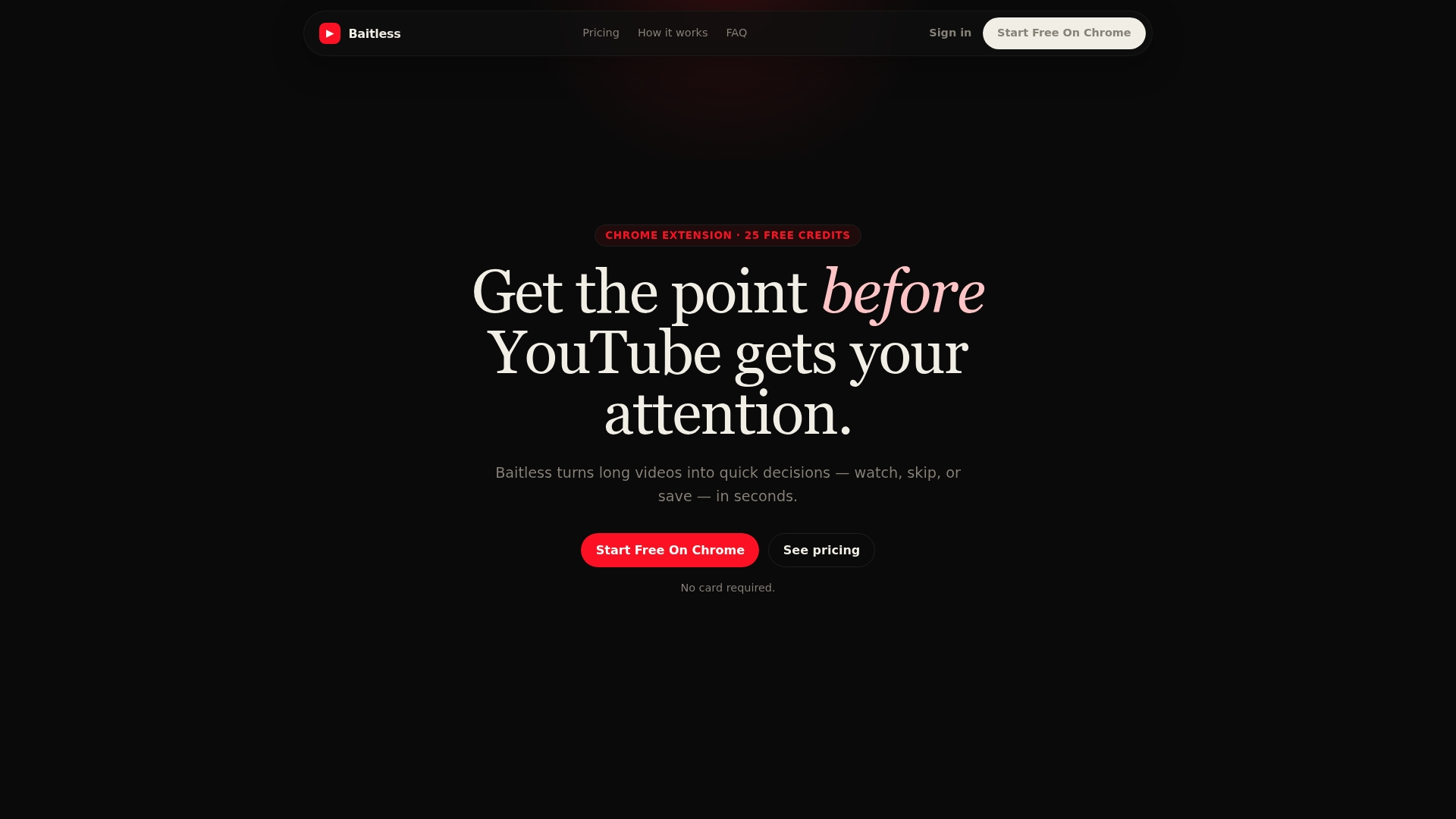
- Install the Baitless extension and open any YouTube video you have been meaning to watch.
- Use your 25 free summary credits to see the watch or skip recommendation and timestamped highlights.
- Upgrade to the Pro plan for $7.99 per month only if you find yourself running out of free credits.
If you want a deeper walkthrough with screenshots, the desktop summarization guide covers the full process step by step, and the ChatGPT and YouTube guide goes further into how the transcript-to-summary pipeline actually works.
Sources
For the install process itself, Chrome’s extension help page and YouTube’s transcript documentation are the primary references. Readers who want the technical detail behind transcript-to-summary pipelines can read the 2024 video summarization pretraining paper or browse more how-to guides on the topic.
- Install and manage extensions - Google Chrome Help
- Correcting auto-captioning (La Salle University guidance)
- Scaling Up Video Summarization Pretraining with Large Language Models
- Whisper model and LexRank for YouTube transcription and summarization - JAIEA
FAQ
Is there any way to summarize YouTube videos automatically?
Yes, Chrome extensions can pull a video’s transcript and condense it into a summary with timestamps in about a minute, following the standard install steps in Chrome’s extension guide. Quality depends on caption accuracy, so results vary by video.
How do I summarize a webpage in Chrome?
Webpage summarizers work similarly to video summarizers: install an extension from the Chrome Web Store, grant it access to the current page, and click its icon to generate a condensed version of the text. Some extensions handle both webpages and YouTube transcripts within the same tool.
Where can I find the YouTube summary once it’s generated?
Most extensions display the summary in a side panel or popup right on the YouTube page, and some also let you copy it to your clipboard. Look for the extension’s toolbar icon near your browser’s address bar after you request a summary.
Is there an AI summary plugin for Chrome?
Yes, several AI-powered extensions in the Chrome Web Store generate YouTube summaries, including Baitless, which offers 25 free summary credits and a $7.99 per month Pro plan for heavier use. Extensions vary in whether they preserve timestamps, so check the listing details before installing.
What should I do if a video has no usable captions?
If a video lacks captions or they are too inaccurate to trust, a transcript-based summarizer will struggle to produce a reliable result, a limitation YouTube itself acknowledges for automatic captioning. In that case, watch the relevant section directly rather than relying on an automated summary.